The Case for Conversation Analytics, Insight and Action Platform.
The recent shift to cloud contact center environments has driven enterprise contact centers to make significant investments and strive to achieve varying levels of digital transformation. In many cases, the move to the cloud had its own internal rate of return in terms of end-of-life contract and platform issues, reduction of support staff, and costly on-premise hardware as well, as well as ongoing difficulty in making changes in legacy on-premise software operating environments.

While the implementation of a conversation analytics, insight and action platform, can help enterprises achieve all these objectives, operational budgets and pressures leave contact center leaders and business executives with a need to objectively classify and estimate the return on investment.
This short guide features real-world use cases and sample parameters that our customers have used to assess and measure the value and the impact of these tools. Each case can work as a stand alone or in combination to demonstrate the self-funding value behind a platform that can help unlock data and put information into action to drive a clear and tangible return.
Our instructional use cases rely on a normalized example of a 1,000 agent contact center to illustrate estimated scenarios. To customize this for your contact center, book a meeting with our solutions team.
Five common use cases to help evaluate the return on your strategy
USE CASE 1: $3MM operational savings annually
Get the Most from Intelligent Virtual Assistants
Self-service options are preferred by many customers while improving resource efficiencies. The extent to which you can maximize these benefits depends greatly on what type of chatbot, textbot, IVR, or IVA is implemented and how well you tune it. Within that deployment, success level is dependent on how well the assistant is integrated with data from other systems, the quality of speech recognition, whether the proper intents are selected, how well automation is designed around real-world cases, and most importantly, how well these methods are evaluated and tuned. You can achieve value at two core stages, first at deployment, but no automation project starts off with a bang. They all require relentless time, attention, and tuning. First let’s take a look at creating value in a new deployment.
1. Increasing deployment velocity
The immediate goal with most IVR and IVA chatbot deployments is determining how to recognize and verify the identity of the caller. Once identity configuration is satisfactory, evaluating intent paths for routing and handling is critical to a successful deployment. Setting up automation is high priority in achieving value from the system. These key categories of insights are needed for deployment:
- How will the customer be identified?
- How are your customers interacting with your bot?
- Which bots are capturing which intents?
- Do customers like your bot?
- Is this task better suited for bot or website self-service?
- Can the bot achieve success?
The legwork in analyzing identity and intent paths can be time consuming yet critical to achieving a successful deployment. With a conversation analytics, insight and action platform, you can get these questions answered faster.
Determine what to automate
Using built in data connections and a set of out of the box reports, you can quickly converge structured and unstructured data quickly evaluate identity and intent paths.
“SuccessKPIs automation engines allowed us to evaluate each part of a conversation, and effectively coach and empower our agents while taking coverage from a small human sample to 100% sampling.”
VP of Engagement, Government BPO
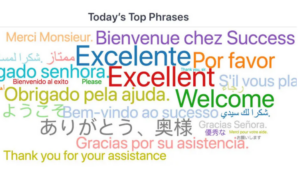
Customers using SuccessKPI’s speech and text analytics, and sentiment analysis have cut between two to four months off an expected IVR and chatbot project deployment. A faster path to discovering important insights such as the ability to identify the types of call attempts through use of effective speech analytics and reporting has the potential to significantly reduce the time of deployment projects. This time savings alone can justify the deployment of a modern analytics platform.
Example scenario
In a scenario with a 1000-agent contact center fielding 600k calls per month (or 3 million minutes handled monthly), a two-month faster deployment yields an operational savings of $370k
2. Tune a deployed environment
Does your bot need enrichment? Learning to tune automation is the secret to high success environments. Significant savings is achieved through more rapid assessment of key insights about intents, which yields better automation results. Some other common side effects of improved automation include:
- Lowered agent frustration and increased agent retention. Sending calls to the right support path keeps agents focused and reduces customer frustration associated with routed calls.
- There can be an increase in average handle time on the remaining calls as those calls that may not be automated are typically more unique or complex in nature.
The highest return comes from increasing automation that takes the burden off humans. But if your bots are causing sentiment erosion and lack conversion, you can see automation plateau and agent handle time rise. While the top candidates for automation are high transaction, lower intensity activities, we need to be selective and pick automation that customers will “enjoy” going through. Achieving five great customers transactions will fare a better outcome than four good bots and four mediocre bots (even if the direct automation tells you differently), so be selective and ensure your high performers are separated from the low performers quickly before your bot gets a bad name.
Example scenario
With an expected base rate of automation at 10% and an achieved rate of automation with Conversation Analytics of 15%, the 5% additional automation achieves 3MM annual operational savings.
USE CASE 2
Reduce Agent Churn – $1MM in agent churn savings
Contact center roles have an annual average of a whopping 30-45% churn rate–typically the highest of any role in the company.
The work is becoming more difficult as the “easy” communications are handled by customer self-service and AI-driven support options, while increased demand is not always met with new training and support.
Sixty percent of agents report1 that they do not have the tools they need to address challenges in the customer facing part of their job. An overload of disconnected tools leaves both agents and customers frustrated with collecting the same information repeatedly. This also means agents need to use multiple tools to determine and solve a customer’s issue. Common monitoring and management tools may even overlook many agents’ skills leading to frustration and disconnect between agents and management.
Reducing agent churn has clear financial benefits. Conversation analytics, insight and action can help agents in many ways including: • Identify which agents need training quickly
- Detect erosion in agent sentiment across calls and across time
- Provide alerts to supervisors of agent/customer crisis situations, including bad customers (yes they exist!)
- Real-time prompts to help agents to act faster and more effectively in the moment
- Better ongoing training and support based on aggregate learnings and tailored to induvial performance and needs
- Streamlining information and tools to unify the executive, supervisor, and agent view
Conversation analysis across all channels provides a 360 view of what is going on for your customers and agents. A proper deployment brings together agent information–tenure, training, and supervisor information–with quality management scorecards, automated ML-based scores, sentiment across channel, agent efficiency metrics such as occupancy and number of holds, and disposition outcomes in the CRM or other system of record.
By better understanding customer service though including all data sources in the customer experience (CX) journey, you can more efficiently plan staffing and workforce needs, understand what agents need help now, and tailor training and feedback to help some, coach others, and praise the aces.
Additionally, giving agents the training they need to ramp quickly in addition to in-call prompts and real-time guidance speeds up ramp time, reduce fatigue and frustration, and improve business results.
“Agents care about their performance and SuccessKPIs scorecards and evaluation tools helped us provide fair feedback that helps agents improve and stay motivated.”
Director of Contact Center, Education Industry
Example scenario
In the 1000 seat contact center example, the customer scenario achieved a 25% improvement in churn resulting in more than $1MM in churn savings. We calculated this by identifying the starting monthly and annual churn rates, how many weeks of training and ramp are needed to replace agents and evaluating what attribution level is attributed to the gains from SuccessKPI.
USE CASE 3: Saving $2.5MM by reducing churn
Improve Customer Experience to Reduce Customer Churn
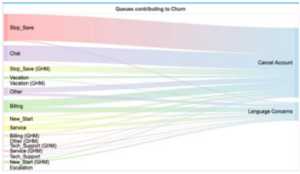
An additional way to leverage conversation analytics to achieve tangible and direct financial savings is to improve customer experience, resulting in reduced customer churn.
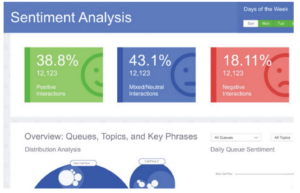
Opportunities for improvement can be discovered when you start identifying which agents are driving negative sentiment, which transactions are causing negative sentiment or causing customers to leave, prevent potential cancels using real-time agent assist, and use post call analysis with feedback with tuned scorecards. The ability to rapidly understand and act has a direct, positive impact on the customer experience.
There are two ways you can measure this. The first is with direct customer churn.
This is a very simple metric that is easy to track. Customers take a baseline measurement of their churn, look at the lost revenue, and then set target improvements to track against. As improving customer churn can be attributed to many variables, we agree on an attribution level based on the types of improvements customers are seeing with their deployment.
The second way to measure is improving the NPS.
Keeping the pulse on customer experience through net promoter score (NPS) is top of mind for most executives. Understanding sentiment is important, yet without the ability to make real-time improvements, it is difficult to move the needly quickly. Technology unlocks the potential to not just improve this, but potentially outgrow the idea of the NPS
“SuccessKPI transformed our view of the customer into actions that improved retention and our bottom line.”
VP of CX, Collection Industry
altogether. When you can identify negative sentiment in the moment, send real-time prompts to agents, and solve challenges on the spot, your ability to improve experiences drastically increases. And when you can correlate sentiment to outcomes in your CRM system or to call types and reasons for dissatisfaction, you can study these transactions in realtime listening to live calls from real customers topically selected by the AI engine. This create fast learning loops to study in detail what is hurting CX.
While it is advised to not overly focus on small changes in NPS, when you look at it over time, by moving percentage NPS a point up by even a single percent, you can make meaningful impact on CSAT and other longer-term metrics if you focus on the processes, moments, and agents that are degrading the customer experience. A rich conversation analytics platform helps you find these suspects and work on addressing them diligently.
Example scenario
Considering a 10% improvement in NPS, resulting in a reduced net churn of 9%, the customer scenario yielded $2.5MM retained revenue through preventing churn.
USE CASE 4: Saving $2MM by improving agent efficiency
Improve agent efficiency
Agent inefficiency can be caused by any number of reasons. To name just a few:
- Agents are overworked.
- Agents are not trained in how to have efficient conversations and how to get things done at your firm–they simply don’t know, or they don’t know how.
- Agent utilization is too high. In these cases, agents may choose to slow down or put customers on hold or increase after call work time because they are exhausted.
- The list goes on, but getting real-time feedback and prompts to help agents is key to improving this.
You can quickly identify which agents need training through speech analytics tools.
Create an agent efficiency monitor, a Hive in SuccessKPI, to allow for:
- Rapid identification of who needs training. Identify who is saying things like, “I don’t know” or “let me check” metric-based approach in identifying who’s being put on hold.
- A sentiment-based view to evaluate who is having conversations change from positive to negative sentiment.
- A completion-based approach, where you identify which agents finish by comparing CRM results to the actual live conversation.
- And even just listening to the top and bottom quartile performers on back-to-back calls (this is critical) of the same call type where you use AI and business intelligence to select long talkers and short talkers on the same subject to build awareness of how to coach the laggards.
The comprehensive approach is combining all of these into one unified dashboard.
Example scenario
Reducing ATT, hold time, and the need for help from a supervisor has direct and tangible savings for our customers. Hive has helped customers to identify trouble agents and zero in on targets for improvement, achieving rapid and measurable improvements.
One example is how the Hive has reduced talk time for our customers by 5% with a 10% reduction in transfers. In that same 1000 agent contact center with 600k calls per month, a 5% reduction in talk time saved 90,000 minutes. And 10% reduction in transfers results 15,000 saved minutes. This yielded more than $2MM in annual savings.

USE CASE 5:
Creating $2.8MM in value with Modern Quality Management
Modern Quality Management (QM)
Agent scorecards have existed for more than a century from when the first Bell System operators were scored on a live plug-in board. It took until the 1990s for call recording to make it more efficient to listen to calls but even then, a lot has been lacking. With a modern conversation analytics platform, value is quickly unlocked under two key themes: Directed QM, and Automated QM.
The Current Method of Operation
In a typical contact center environment, agents and quality managers have a bogey of calls to complete on scorecards each week. In the worst case, these are scored in XLS or SharePoint and simply used to report and give feedback to agents. Calls are typically selected randomly or by some method designed to give a broad cross section of agents. Inevitably the agent gets feedback on 1-2 calls per week at best and the feedback is anecdotal, sometimes unfair, and based on less than 1% of their work. Even if the agent is struggling, it feels punitive to get negative or even middle of the road feedback on two calls when your body of work far exceeds this.
Enter Directed Quality Management
With directed quality management, we employ automation, process management tools, a 360-degree view, business intelligence, and AI and ML to get a full picture and give a more comprehensive view of the team. We start with a fully
“Customers will never love a company until the employees love it first.”
Simon Sinek
automated transcript which is paneled alongside agent screen views and live call recording. The call recording is visually enhanced with cues to see topics, sentiment, overtalk, silence, hold time and other actions to give a fast glance of the interaction. AI not only flags topics and sentiment as it transcribes the call, but it filters calls. Selection windows allow you to find calls of a certain agent, queue, talk time, hold time, topic type, and disposition code. And easy to use forms enable you to score calls quickly with radio buttons, pull down menus, AI powered autofill and a variety of question types from “yes/no” to multiple choice and free form. Process management tools allow you to progress scorecards from started, completed, submitted, and coached. Agent scorecard views allow you to share not only the score but the actual call with the agent including footnotes of your feedback. And finally, the QM details flow into the data warehouse allowing you to run full 360 reviews across a cumulate body of dozens of scorecards by supervisors juxtaposed against agent data (AHT, talk time, number of holds), speech data (key topics, sentiment, even the number of times they said “I don’t know”), and dozens of other key information points. Having a powerful QM tool that is fully integrated and fully imbued with AI, search, and visual cues directly saves supervisor time and enhances their ability to do more work, to complete it more fluidly, and to create a superior environment to empower your supervisors and agents to improve customer experience.
Example scenario
In the normalized 1000 agent contact center with 600k calls per month, an average of 67 supervisors were needed with 16 quality managers. A 10% reduction in the amount quality managers needed provided 800k in operational savings.
Automated Quality Management
While these tools are incredible for improving agent coaching conversations and making supervisors and quality managers more efficient, a modern conversation analytics platform also delivers a whole new set of capabilities by providing automated quality management. With each scorecard completed by your team, a powerful body of computer learning data is being assembled. By the time we reach 500 or 1000 scorecards on one type of evaluation form, the machine is ready to learn.
With SuccessKPI, you can quickly and easily select a scorecard and a time period and our agent learning tools immediately begin crunching the questions and answers while our AI tools interpret the sentiment, topics and themes and it learns. It learns so well that within a few days, our machine learning models can then apply that learning to scoring calls automatically. How do we know that this works? Because over the weeks following automation model deployment, we take machine scores and compare them directly to the continued manual scores by our supervisors and produce correlation and calibration reports to keep automations in check. With high volume environments of 250 agents or greater and a minimum of 1000 scorecards, 90%+ machine score accuracy can be achieved for most question types yielding a powerful tool for your organization.
Some use this for compliance, others for direct cost savings, others to increase coverage, and to give 100% feedback on all calls to agents far-exceeding previous generation feedback loops. The ROI savings of such automation is quite compelling whether you are calculating the benefit of 10,000 scorecards that are fully automated or the reduction in time spent by supervisors and QM team members required to achieve success.
Example scenario
In that same 1000 agent contact center — with automated QA — a 10% reduction in supervisors and 50% reduction quality managers needed is achieved, paired with the value of increased new surveys, the scenario yields more than $2MM in value.
Schedule an ROI workbook session to estimate your potential return
Summary
The bottom line: any one of these use cases can create a self-funding and viable business case. Additionally, while the bottom line is often the most critical business metric, there are also qualitative benefits that should not be overlooked. You can make your contact center a better place to work and deliver a better experience for your customers, which also makes it better for your agents and your supervisors who are on the front line delivering to your customers every day.
Future Cases
There are a more than a dozen additional use case areas under deployment by our customers. New studies are currently underway in our laboratory including the following features and benefits:
- Automated disposition coding which saves wrap up time at the agent level
- Real-time agent guidance which delivers cost savings and reduces customer time on hold
As we continue to demonstrate new objective level evidence to support your return on investment planning, check back for updates to the Case for Conversation Analytics.
Do you have a conversation analytics value story to share?
Let us know at customers@successkpi.com
This short guide features real-world use cases and sample parameters that our cutomers have used to assess and measure value and the impact.
Each case can work as a stand alone or in combination to demonstrate the self-funding value behind a platform that can help unlock data and put information into action to drive a clear and tangible return.